Ghost in the Grid: How Ryuichi Sakamoto's Compositional DNA Quietly Runs Through Bedroom Pop and Lo-Fi

Photo: Preparetavalise.com, CC BY-SA 4.0, via Wikimedia Commons
Somewhere in a rented apartment in East Nashville, a producer layers a piano sample beneath a stuttering drum loop, then deliberately lowers the reverb tail until the note feels suspended rather than resolved. In a college dorm outside Portland, another musician records a guitar line and, instead of correcting the faint hum bleeding through the interface, decides to keep it. Neither of these artists is likely thinking about Ryuichi Sakamoto. And yet, the decisions they are making—the preference for texture over clarity, the trust placed in silence, the intuition that imperfection carries emotional weight—belong to a compositional philosophy that Sakamoto spent the better part of five decades developing and refining.
This is not a story about direct influence in the conventional sense. It is a story about how ideas migrate through culture without attribution, how a sensibility becomes infrastructure.
The Architecture of Less
Sakamoto's relationship with restraint was not a stylistic affectation. It emerged from a genuine philosophical inquiry into what sound could mean when stripped of ornamentation. Throughout his solo catalog—from the spacious melancholy of Thousand Knives to the crystalline minimalism of async—Sakamoto consistently demonstrated that a note withheld could carry as much narrative force as one played. He understood that the listener's imagination, given room to operate, becomes a collaborator in the work.
This principle sits at the center of contemporary lo-fi production, even when its practitioners have never heard it articulated in those terms. The genre's characteristic understatement—its resistance to the maximalism that dominates mainstream pop—reflects a structural logic that Sakamoto was applying to electronic music long before bedroom recording became viable for independent artists. When a lo-fi producer leaves a chord unresolved or allows a melody to dissolve before completion, they are operating within a tradition that Sakamoto helped establish, even if the genealogy has been obscured by time and the informal transmission of aesthetic values through streaming playlists and YouTube tutorials.
Imperfection as Intention
One of the more revealing characteristics of Sakamoto's later work is its deliberate incorporation of sonic irregularity. On async, released in 2017, he recorded piano notes through rain-soaked wood, allowed environmental noise to become part of the harmonic fabric, and treated technical limitation as a compositional resource rather than an obstacle. The result was music that felt genuinely alive—unstable in the way that living things are unstable, responsive to conditions beyond the composer's control.
Bedroom pop, as a genre, is defined by a similar acceptance of the uncontrolled. The compressed dynamic range, the audible room noise, the slightly off-tempo vocal take left in the final mix—these are not failures of production. They are, for many artists working in this space, affirmative choices. The rawness signals authenticity; the imperfection establishes intimacy. What Sakamoto reached through rigorous artistic inquiry, a generation of independent American musicians has arrived at through the practical constraints of limited budgets and untreated recording spaces. The destination is the same even if the paths diverged.
Layering as Language
Sakamoto's approach to layering was always more conversational than decorative. Rather than stacking sounds to create density, he used texture to generate dialogue—between frequencies, between timbres, between the organic and the synthetic. His collaborations with artists as varied as Alva Noto and David Sylvian demonstrated an understanding that a layer only justifies its presence when it is listening to what surrounds it.
This relational approach to arrangement is increasingly evident in the more sophisticated corners of the bedroom pop and lo-fi scenes. Producers like Clairo, Men I Trust, and Hovvdy—artists who have cultivated substantial American followings through their atmospheric, low-key productions—construct sonic environments in which each element occupies a distinct spatial role. The bass does not compete with the vocal; the synth pad does not crowd the guitar. There is a spatial awareness in this work that mirrors Sakamoto's compositional priorities, a sense that the arrangement is a room and the listener is standing inside it.
The Studio as Instrument
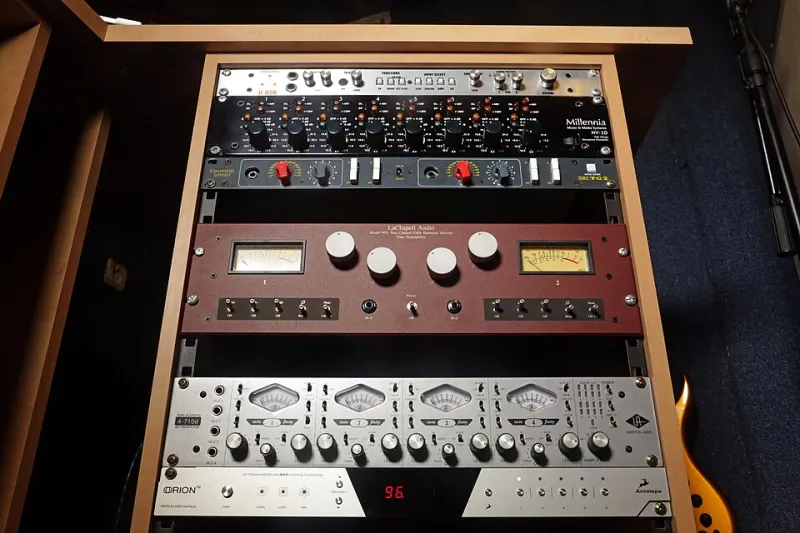
Perhaps the most significant parallel between Sakamoto's practice and the contemporary DIY movement is the treatment of the recording environment itself as a compositional tool. Sakamoto was among the first composers in his generation to insist that the studio was not a neutral space for capturing performance but an active participant in the creative process. The choice of microphone, the character of a particular room's acoustics, the behavior of analog equipment under specific conditions—all of these were variables to be engaged with rather than standardized away.
For bedroom producers working with affordable audio interfaces and consumer-grade microphones, this philosophy offers a liberating reframe. The limitations of their equipment are not deficiencies to be apologized for; they are the specific material conditions of their artistic practice. The warmth of a cheap condenser mic, the slight saturation introduced by an entry-level preamp, the ambient noise of a domestic space—these become the sonic fingerprint of the work, the equivalent of Sakamoto's rain-soaked piano. Limitation, understood this way, is not a constraint on expression. It is the form that expression takes.
An Inheritance Without a Deed
What makes this lineage unusual is its largely undocumented character. The producers and musicians building the current wave of American bedroom pop rarely cite Sakamoto as a reference point in interviews or press materials. His name does not appear in the genre's informal canons the way that, say, Elliott Smith or Broadcast might. And yet the values that animate his compositional philosophy—economy, texture, the emotional resonance of negative space—are precisely the values that define the aesthetic.
This is perhaps the most eloquent testimony to Sakamoto's influence: it has become so thoroughly absorbed into the culture of independent music production that it no longer requires a source. The ideas have separated from their origin and are now simply part of the atmosphere in which young American musicians learn to hear.
Sakamoto once described his ideal listener as someone who was not necessarily paying attention—someone who encountered the music peripherally, as part of the texture of daily life, and found that it had nevertheless altered something in their perception. In a sense, his influence on bedroom pop and lo-fi operates by the same logic. It is not announced. It does not demand recognition. It simply works, quietly and pervasively, shaping the decisions of artists who may never know his name while building something that carries his sensibility forward into rooms he never entered.